
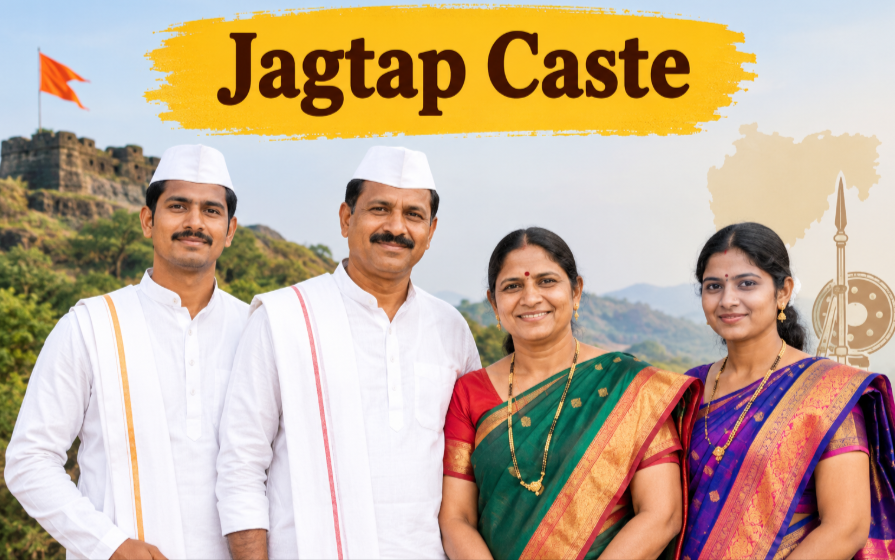
Jagtap Caste is mainly present in the following Indian states:
- Maharashtra
- Goa
- Union Territory of Dadra and Nagar Haveli
The clan is deeply intertwined in the socio-political fabric of western India. It boasts a rich history of:
- Military Valor
- Administrative leadership
- Agrarian Heritage
Here, the word ‘Jagat’ is a Sanskrit word. It means universe, with the suffix tap, which means heat or brilliance. It denotes an entity that performs cosmic protection.
The community’s history and lineage!
The historical lineage of the Jagtap clan is rooted in ancient warrior traditions. The traditional family records trace their ancestry back to Somvanshi and Suryavanshi lineages. According to popular folklore and histories, the Jagtap ancestors migrated from Northern Regions. When they reached Maharashtra, they split into regions like Saswad and Pandhare near Pune.
Know about the interesting 96 Kuli Maratha connection!
In the social hierarchy of Maharashtra, the Jagtaps are celebrated as an important component of the 96 Kuli Marathas. The grouping forms the backbone of the Maratha Empire.
During the pre-Shivaji era, the community served local sultanates in high administrative capacities. They have also served as
- Faithful allies
- Military commanders under Shivaji Maharaj
Their regional presence!
The clan is mainly concentrated in Maharashtra. The name can also be found in neighbouring states as discussed above.
Migration has contributed to its wider presence across the country. They have moved to other parts of the country due to
- Education access
- Employment
- Military service
- Better trade
- Business and many others
Now, the caste is present in various cities as well as towns across the country.
Their cultural traditions or religious beliefs!
The cultural identity of the Jagtap clan is anchored in ancestral traditions. According to Maratha clan custom, the community adheres to various Gotras. They respect sacred natural symbols called Devaks, including:
- Shami
- Kalamb
- Umbar trees
They are devout Hindus who patronise local deities. The clan honours the Goddess:
- Mahalakshmi
- Chirai Mata from Nashik
- Yamai
- Dhanadai
- Lord Khandoba of Jejuri
The community’s role in the Maratha Empire!
During the Maratha Empire’s golden era, the military prowess lineage became highly recognised. The community family served as:
- Valiant generals
- Cavalry commanders
- Regional administrator
One notable historical figure is Godaji Jagtap. His extraordinary bravery at the time of the Belsar and Purandar wars is known to all.
Social classification and caste identity!
Jagtap is primarily identified as an influential clan. It comes under the 96 royal clans. Some genealogical sources list:
- Specific gotra
- Devak
- Kuldevata traditions
Their role in the Maratha Empire!
The military prowess of the Jagtap lineage at the time of the Maratha Empire under:
- Chhatrapati Shivaji Maharaj
- Other Peshwa rules
The warriors have several roles:
- Valiant generals
- Cavalry commanders
- Regional administrators
Some evidence from caste records!
In August 2026, in a Bombay High Court matter, people with the surname were identified in connection with Kunbi caste claims and caste validity proceedings. A separate 2025 validity record concerns the Jagtap family, which was verified as Maratha.
Their language and culture!
Jagtap families are connected with Marathi culture. Families speak the regional languages according to their geographical location. Migration has created multilingual households. Traditional festivals and family ceremonies are also very important. They celebrate
- Ganesh Chaturthi
- Other regional celebrations
Modern Jagtap families!
With the decline in kingdoms and the evolution of modern governance, the lifestyle, occupation and living of the community have changed. Now, they have adopted various professions like
- Commercial agriculture
- Education
- Public service
With educational facilities, they are working in a diverse range of fields.
Conclusion!
The clan represents a vibrant cultural tapestry of India. It bridges the historical martial tradition with modern values. They are now engaged in:
- National administration
- Business and tech industries