
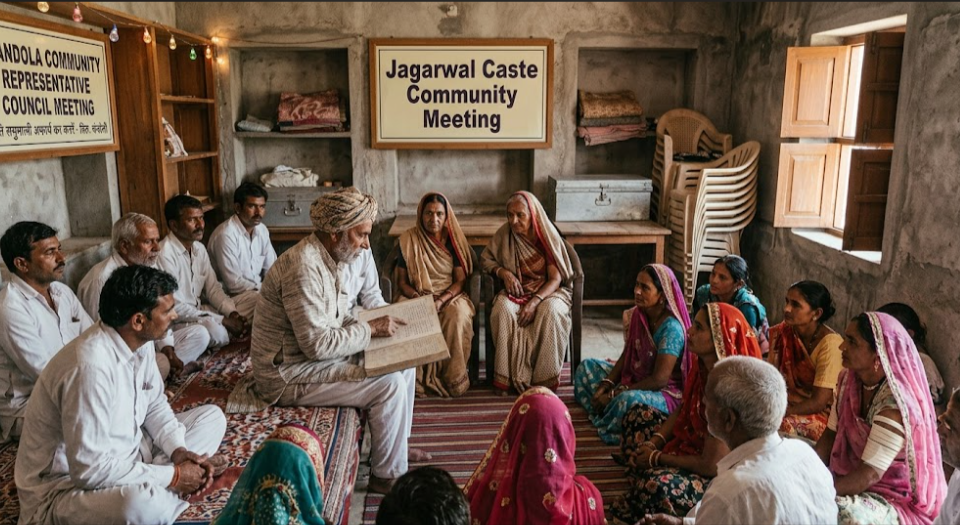
The Jagarwal caste is found mainly in the northern parts of India. They are mostly present in these states:
- Rajasthan
- Haryana
- Madhya Pradesh
Over generations, the community has maintained social identity within the traditional rural and semi-urban landscape.
Their historical origin and identity!
Their roots have been connected with:
- Agriculture
- Landowning traditions
In traditional Indian societies, community structures revolved around farming and land. They traditionally worked as:
- Farmers
- Cultivators
- Protectors of local community resources
Oral histories play a large role in heritage. Elders tell their stories to their next generations regarding:
- Migration
- Honour from one generation to another
- Kinship
All these stories show:
- Resilience
- Hard work
- Loyalty to community
Their social structure and kinship!
Social life within the community is highly organised. They practice endogamy.
Endogamy: It is a marriage practice in which marriages happen within the same broader caste framework. However, they strictly prohibit clan marriages.
Family structures have traditionally been joint or extended. Large families live together to manage agricultural land and other resources. Decisions are generally guided by the family elders.
Folk music and traditional dance are an important part of celebrations. Weddings in the community are important. They involve:
- Multi-day rituals
- Traditional songs
- Feastings
Their practices preserve their heritage.
Know about their culture, festivals and other religious practices!
The Jagarwal community participates in mainstream Hindu religious traditions and culture. They worship:
- Regional deities
- Ancestral gods
Standard Hindu Gods named
- Shiva
- Krishna
- Hanuman
Also, they worship their clan’s god named Kuldevi or Kuldevta during their major life events.
They also celebrate festivals with great enthusiasm like:
- Holi
- Diwali
- Teej
During these events, traditional folk songs and dances are performed.
Their traditional attire!
- Dhoti Kurta for Men
- Ghagra Choli
- Colourful veils for women
Understanding their economic transition!
Historically, agriculture was the economic backbone. They relied on:
- Cattle rearing
- Seasonable crops
- Dairy farming
However, their economic landscape has transformed now. Urbanisation and agricultural economics have pushed the younger generation towards other career opportunities. Now, they are involved in various other sectors like:
- Businesses
- Trade
- Public and private sector jobs
Their spoken language!
Jagarwal families live in northern India. They speak Hindi or other regional languages. Other languages they spoke are:
Punjabi
- Haryanvi
- Rajasthani or other languages
Education and modern development!
Education works as a catalyst in helping the community. There is increased access to schools and universities. Youth are focusing on education at a higher rate. With this growing emphasis, they are working in various sectors. They are holding various positions in various sectors, such as:
- Law enforcement
- Teaching
- Government jobs
- Administrative services and so on.
Modern challenges and outlook!
They are also trying hard to face the challenge of balancing modernity with heritage. The younger generation is living a modern life while carrying their heritage along.
The younger generation has moved to the urban centres.
Institutional and community welfare!
The Jagarwal community has emerged to tackle all the challenges. These groups are working at various levels. They organise mass weddings to reduce marriage expenses.
They work at the grassroots level to create a strong sense of solidarity.
Conclusion!
The Jagarwal caste shows a rich legacy in terms of:
- Their spiritual devotion
- Administrative capability
- Historical pride
They have successfully preserved their cultural values. Also, they have contributed in economic progress of the country.