
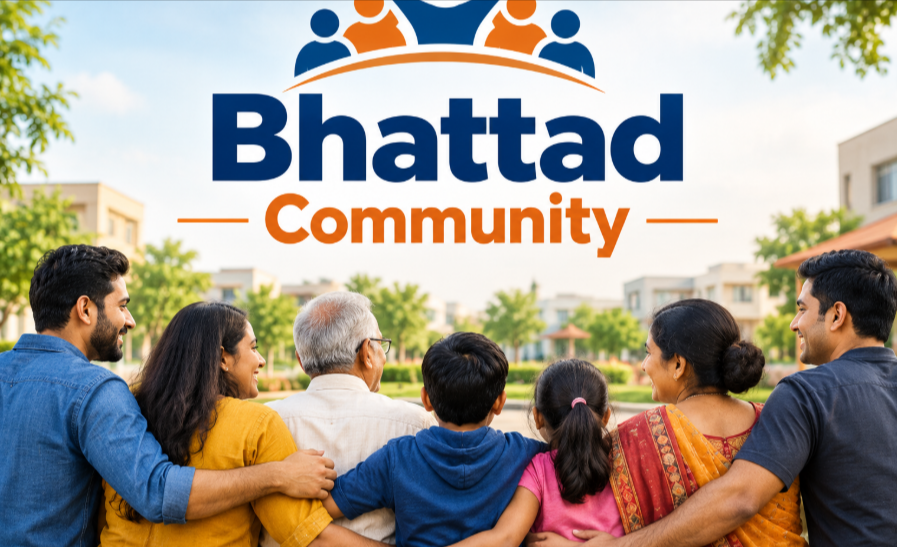
The Bhattad cast represents a prominent family lineage. It is deeply rooted within the Maheshwari Samaj. It originates primarily from the desert state of Rajasthan. Historical information about this small community is limited. Their heritage also comes from traditions. Local records can be consulted for additional information.
Simply, the Bhatta community refers to learned people or scholars. The title is given to those who have mastered the Vedas and manage local governance.
Know about the historical background!
The community has a long history. Their history is connected with regional social development. They preserve their family customs. Different families settled in various regions.
The community’s placement within the Maheshwari Samaj!
The Bhattad community is celebrated as one of the 72 traditional clans. The Maheshwari Samaj possesses spiritual markers.
- Gotra
The lineage traces its spirituality to the Bhattayan Gotra.
- Kuldevi
The patron deity of the clan is Shri Bhadaria mata ji.
Sacred geography
The temple is located in the historic region of Jaisalmer in Rajasthan.
Assessing the identity of the community!
The community identity includes customs, family traditions, and other practices. They may have cultural practices depending on where they live. Surnames also vary.
Geographical expansion and Diaspora!
Their basic roots remain tied to the sands of Rajasthan. However, the historical shifts prompted the community to expand. In the 19th and 20th centuries, families migrated. Also, a huge part of the community migrated to other states like:
- Maharashtra
- Madhya Pradesh
- Andhra Pradesh
- Telangana
Their socio-economic evolution: From Shastras to business!
The trajectory represents social adaptation. They are a part of the Maheshwari community. Traditionally, they excelled in trades such as textiles and grain. Now, traditional occupations depend on local economic conditions. Some families engage in agriculture. Others may be involved in farming or similar activities. Trade and small businesses are quite common. Skilled occupations are also developed in families. Education has increased their career opportunities. The younger generation is present across various sectors. They are now working in:
- Manufacturing
- Corporate leadership
- Information Technology
- Real estate
- Healthcare
Know about their cultural traditions and social values!
Traditional values are often shared between generations. Festivals provide opportunities for relatives to meet. Their culture prioritizes:
- Philanthropy
- Vegetarianism
- Deep spiritual devotion
They are followers of Shaivism and Vaishnavism. Family structure remains close-knit. They celebrate various festivals like:
- Diwali
- Raksha Bandhan
- Mahesh Navami
Music and traditional celebrations can also contribute to community culture. The events allow one to reconnect and preserve their heritage.
Rites and customs followed during marriages!
Regional customs influence wedding ceremonies. Families follow traditional rites. Relatives and friends participate in celebrations. Modern people influence the traditional pattern of marriages.
Education has changed marriage practices. The modern lifestyle has influenced traditional customs. Individual preferences also matter today. Social media has made communication easier. It has become easy for people to connect. It has also played a role in making marriage alliances. Digital platforms also help preserve cultural memories.
In modern times, the community has balanced traditional family values with educational attainment. Family-owned business remains a strong pillar of identity. Many professionals are working as:
- Chartered accountants
- Corporate lawyers
- Medical professionals
- Technology executives