
Other names of the Kuntal caste are:
- Khutail
- Khuntel
- Kunthal
However, Kuntal can’t always be identified as one single caste across the country. It can be used as a:
- Surname
- Clan name
- Family name
Its meaning may change according to:
- Region
- Family history
- Community tradition
What Does Kuntal Mean?
Kuntal is a name found among families in different parts of India. Kuntal can refer to a lineage or historical group.
Their historical background!
Indian communities develop through centuries of:
- Migration
- Occupation
- Political change
- Regional traditions
They have functioned under a strict system of exogamous clans. It stands out as an elite lineage.
Their regional connection!
Kuntal is not restricted to one Indian state. It can be found in various parts of the country. Migration results in their wider distribution.
Their Tomar connection and clan rules!
The Kuntal Gotra has an inseparable bond with the Tomar Jat clan. Kuntals are a direct sub-clan. They trace their ancestry back to descendants of legendary Maharaja Anagpal Tomar. He was the celebrated ruler of Delhi.
Learn about the caste and clan identity!
Remember, caste and clans are not the same thing. A caste refers to a broader social group. However, a clan can identify a particular family branch.
Mythological roots and Pandava ancestry!
The Kuntal clan traces its origin back to the Chandravanshi (Lunar) lineage. Records say that the name Kuntal comes from the queen Kunti.
The strong connection to Arjun and the Pandavas gives the community great pride.
Their traditional occupation or rural connection!
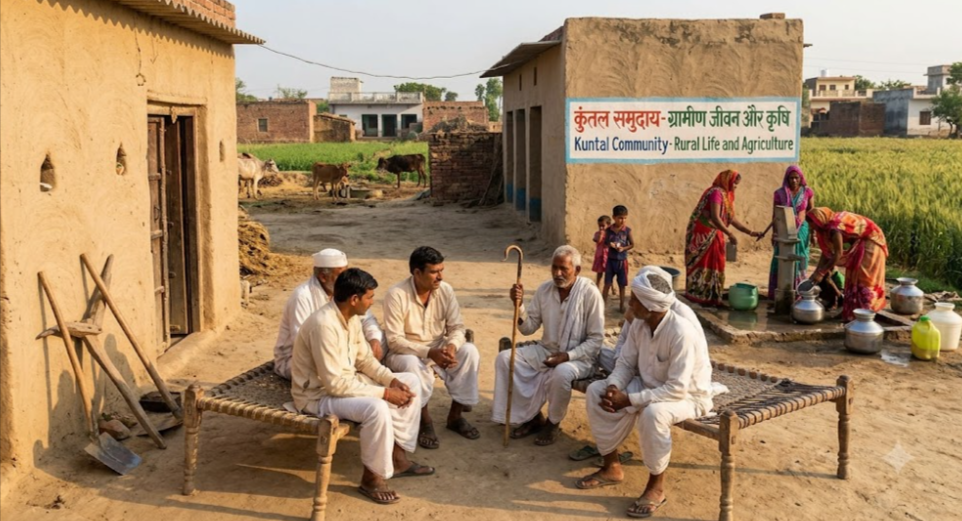
They have a historical connection with rural communities. Their livelihood depends heavily on:
- Agriculture
- Military landlords
- Land cultivation
- Livestock
- Local trade
However, occupations also vary by region and lineage.
Their geographical distribution and Kuntalpati!
The geographic core of the Kuntal population lies within the Brij region. It spans across the broad areas:
- UP
- Rajasthan
They are densely concentrated in Mathura district of UP. They are also present in Bharatpur district of Rajasthan. Other parts where the community resides are in:
- Haryana
- MP
Their Martial history with notable leaders!
The Kuntals maintained a fierce reputation as:
- Warriors
- Independent landlords
When the Mughal Empire began to decline, Kuntal leaders asserted their independence—Raja Taufa Singh of Sonkh.
Another important figure is Pakharia Singh of Gunsara.
Modern identity and social standing!
The Kuntal community has successfully transitioned from their traditional role as military landlords to a diverse range of sectors. They are still successful in fields like:
- Agriculture
- Administration
- The Indian Armed Forces
- Politics
They are categorized under the OBC category. With access to higher education, they stand as a symbol of:
- Historical resilience
- Democratic participation
- Cultural preservation
Now, young community people are working in a diverse range of sectors like:
- Engineering
- Medicine
- Management
- Law
- Finance
- Agriculture
- Government sector
- Technology
- Education
Higher education has also encouraged migration. They also live in countries outside India.
Urbanization and migration!
Urbanization has influenced community life. Many families have moved to metropolitan areas. Cities provide access to:
- Better education
- Employment opportunities
They bring different cultures together. They lead to changes in:
- Language
- Lifestyle
- Cultural background
Family traditions!
Their important family traditions and customs are:
- Weddings
- Religious events
- Family gatherings
Today’s Kuntal Identity!
Modern Kuntal identity includes various elements. Family history and regional culture are important. Other things that influence their identity are:
- Their language
- Education access
- Religion
- Occupation
- Migration