
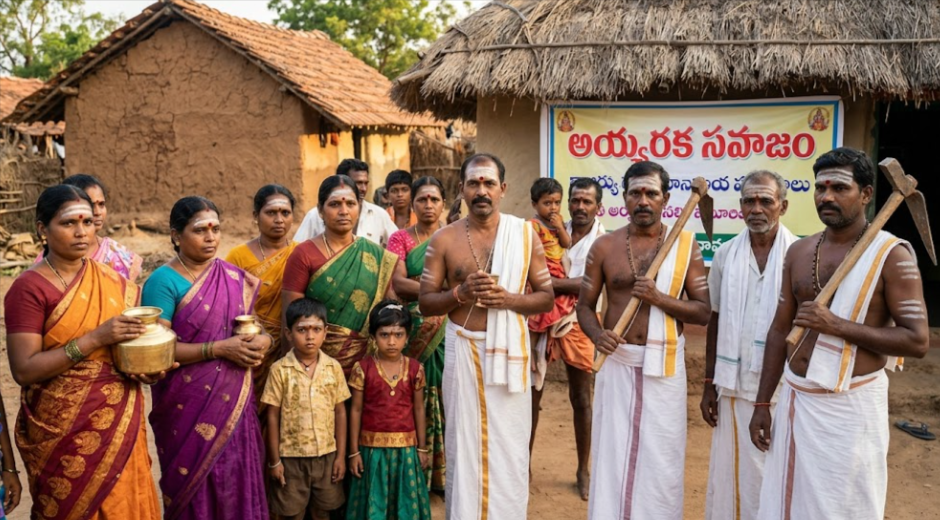
Historically, the community is documented as Aiyarakulu Caste. It is a distinct socio-cultural caste. Mainly, they live in Andhra Pradesh. They also reside in various districts like:
- Visakhapatnam
- Srikakulam
- Vizianagaram
The community is associated with southern India. Knowing local history, family traditions, and occupations reveals a community’s identity. The social position varies in various areas. They have a rich history that bridges martial traditions and agrarian lifestyles.
Historical Background and Etymology!
The community carries a royal connotation. It is connected with the cultural development of the region. The communities are organized around occupations, villages, and other institutions.
In the Telugu language, Ayya translates to “Ruler” or “Head”. Also, Rikam means Nature and Disposition. This means the caste possesses the qualities of a ruler or king. Over time, families have adopted different professions and economic opportunities. They are also working in various sectors, including agriculture, administration, skilled work, and trade.
Their social structure and cultural practices!
The community features a well-defined lineage.
- Gotras
The caste organizes various exogamous clans. Common gotras are Cobra and Tortoise. Further, the clans are divided into family surnames.
- Marital traditions
They practice traditional customs like menarikam. It is a practice in which a man marries his maternal uncle’s daughter.
- Surnames and titles
The community is closely linked to the Patrulu title. Some sections are recognized as Razus. They wear the sacred thread.
Geographical Distribution!
Ayyaraka community is found in various southern parts. The presence of the caste varies from one district to another. Migration has taken place. Families have moved from villages to towns, or from rural areas to urban areas. They migrated in search of education and better economic opportunities.
Today, the community is geographically dispersed across both rural and urban regions. Families have maintained close connections with the ancestral villages.
Know about the traditional and modern occupations!
The ancient profession may vary according to region. A major part of the population is skilled cultivators and landlords. They also manage the local agricultural cycle.
Historically, a major section of the community also practiced traditional medicine. They also engaged in logistics as cart drivers traveling between coastal plains or tracts.
In modern times, the community diversified into various skilled professions and businesses. They are involved in:
- Government services
- Trade
- Higher education
- Corporate employment
- Education
- Private sector jobs
- Small and big business
Young family members are educating themselves. They have chosen careers based on their personal interests and education.
Their contemporary status and governance!
In terms of administrative classification, it comes under the OBC category—the classification designed to foster better education opportunities for them.
They have formed community groups, such as the Ayyaraka Community Association, to preserve their cultural heritage. These groups are important for higher-skill training, corporations, and healthcare facilities. It uplifts the less privileged families.
Culture and Traditions with transformation!
The traditions of the community are a significant part of their identity. Various things that differ are:
- Family customs
- Festivals that they celebrate
- Marriage ceremonies
- Food traditions
- Local celebrations
They celebrate their festivals together.
- Marriage customs
The community practices Menarikam. It is a rule when a man marries his maternal uncle’s daughter. Historically, weddings were officiated by Brahmin Priests. During these weddings, the couple wore silver sacred threads. These threads are melted down later. These are refashioned into ceremonial rings.
- Traditional authority
Their internal community matters. The local civic welfare is monitored by caste. Village heads operate the community.