
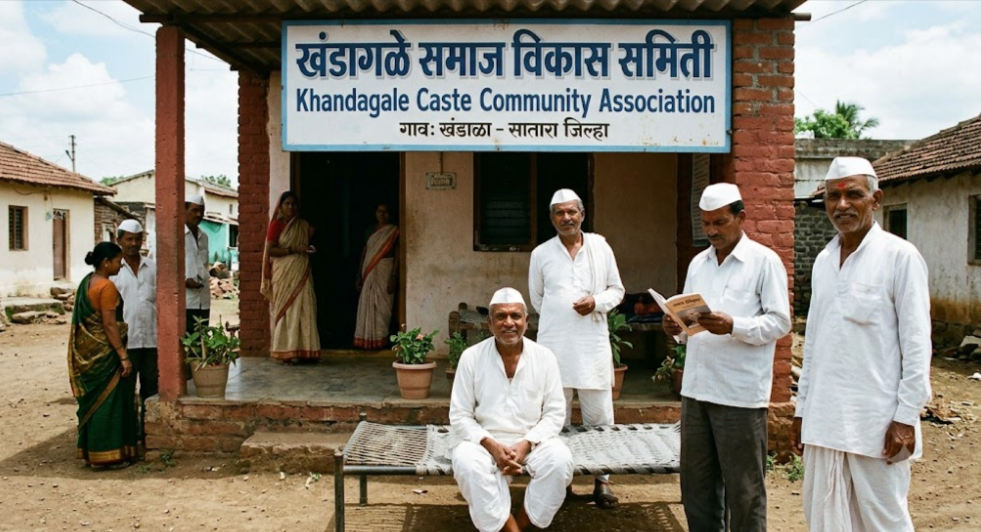
The Khandagale Caste is also spelled as:
- Khandagle
- Khandagale
It is a prominent name found in Marathi-speaking regions. It spans multiple communities within the region. It is not a single and isolated caste group. It comes under the 96 Kuli Maratha surname.
Name origin and etymology!
Etymologically, the name is rooted in geographical heritage. The prefix ‘Khanda’ refers to the traditional Indian double-edged sword. They are famously associated with:
- Historical warfare
- Royalty
Religious icons like Lord Khandoba and Goddess Kali
The name translates to belonging to a sword. Therefore, their traditional occupations are:
- Weapon making
- Military service
- Territorial guardianship
The name is derived from the Marathi word Khand, which means broken or fragmented landscape, and Gale, which denotes communities. Together, the words represent people who live near a rugged landscape.
Their geographical distribution across the caste categories!
The Khandagale lineage appears across various social statuses.
- Maratha (96 Kuli)
The caste is recognized as one of the constituent clans within the 96 Kuli Maratha. It belongs to the Surya Vansha.
- Kunbi
It is an agrarian community. It is closely related to the Marathas. Bearers of the name in this category are historically specialized. They are specialized in:
- Agricultural governance
- Land management
- Local cultivation
- Scheduled castes
An important population carrying the name Khandagale belongs to:
- Mahar
- Charmakar
Many also embraced Buddhism and joined the social justice movement.
Historical Background: The Khandagale elephant incident!
The Khandagale clan holds a definitive place in Medieval Indian history. One of their historic events is Khandagale Hatti Prakaran. They have a long history of
- Agricultural settlements
- Local administration
- Military service and trade
Their caste distribution and fluidity!
The Khandagale surname is not restricted to a single caste block. It demonstrates social stratification.
- Maratha and Kunbi community
Community members belong to Kunbi agricultural castes. Earlier, these families were engaged in administration.
- Koli community
The surname is present as a clan name among:
- Mahadev Koli
- Kengale Koli
The community holds warrior status for local hill passes.
- Scheduled castes
A significant population belongs to the SC group, including Mahar and Chamar. They embrace Buddhism, following social movements led by Dr. B. R. Ambedkar.
Their geographical presence!
The surname is highly localized. 99% of the community lives in Maharashtra. The remaining population is present in other states named:
- Karnataka
- Gujrat
A tiny global diaspora also
- The United Arab Emirates
- The United States
Their geographic distribution is broad. There are also families living in:
- Pune
- Ahmednagar
- Nashik
- The Marathwada region
However, today’s community has shifted away from feudalism. They are now engaged in various occupations. Education has driven urban migration. They are working in various fields like:
- Administration
- Engineering
- Accounting
- Public service
They preserve their ancestral traditions while integrating modern rituals.
The community’s Khandesh Connection!
Khandesh is a historic region of northern Maharashtra. It includes areas connected through trade and agriculture. However, there is no proof that each Khandagale family originated from Khandesh.
Their Gotra and Devak traditions!
Some Gotras are listed in the 96 Kuli Maratha list. Others are associated with the Vashishta Gotra and Suryaphul Devak.
Family and marriage traditions!
Marriage ceremonies include regional Marathi traditions. Extended relatives participate in important family occasions. Urbanization has changed various customs. Modern families combine traditional ceremonies with celebrations.
Education access!
Young people are pursuing higher education. They are working in diverse fields like:
- Engineering
- Medicine
- Management
- Law
- Commerce
- Technology
- Government services
- Entrepreneurship
- Healthcare or other areas