
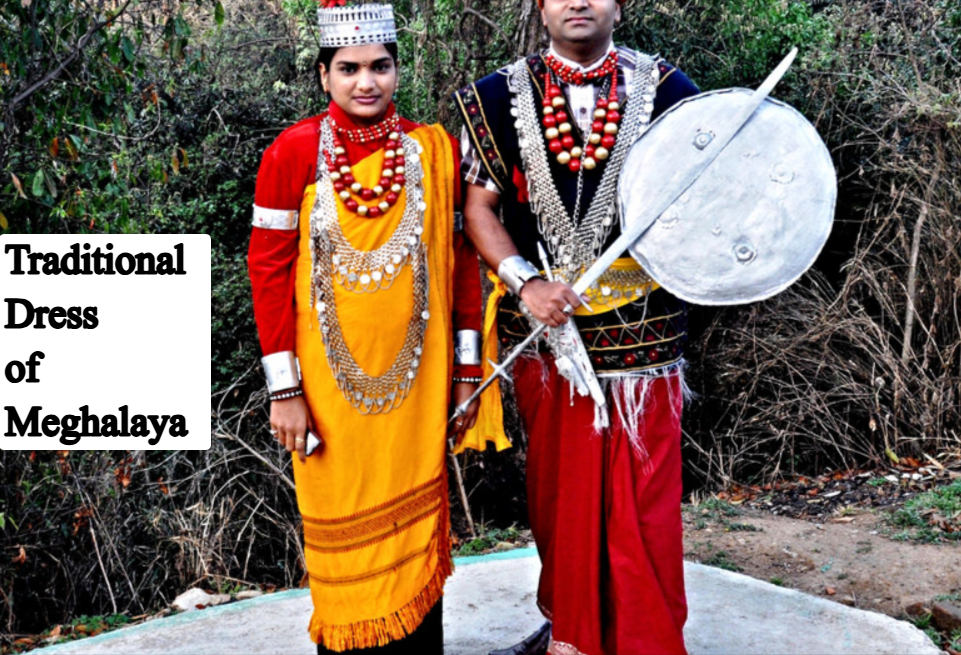
Meghalaya is a state showing its identity through its biodiversity, costumes, and culture. The costumes worn by the major communities like the Khasi, Jaintia, and Garo are different from each other.
Their attires are mainly crafted using sourced cotton, mulberry silk, and Endi silk. Generally, all of their garments are unstitched. They are wrapped around their body beautifully. Different styles are carried according to the climate and region.
Traditional Dress of Meghalaya
Attires carried according to the communities!
- Khasi and Jaintia Attire
Jainsem is quite a popular garment. It is an elaborate and layered wrap-around skirt. It is produced using silk and cotton. Jainsem is worn with an upper garment called Tap-moh Khlieh, which is a traditional cotton shawl.
For formal attire, they wear a Dhara. They also used to wear a Jymphong, which is a sleeveless coat without a collar, along with a turban.
- Garo attire
The community generally wore a Dakmanda. It is an intricately patterned skirt. It falls to ankle-length. It is worn along with a blouse. They also wear Eking. Eking is a shorter wrap-around cloth tied around the waist.
During festivals like Wangala, men used to wear a loincloth along with a turban.
- Karbi (Mikir Attire)
They are well-known for weaving their clothes at home. Men used to wear a dhoti called Rikong, a turban, and an artistic jacket which is called Choi. At the same time, women used to wear a pini, pekok, which is an upper body cloth, and wam kok, which is a waist wrap-around cloth.
At the time of dancing rituals of the Ka Pom Blang Nongkrem festivals, the men carry a sword in one of their hands.
The significance of Ryndia’s silk and weaving in their heritage!
The heart of Meghalaya’s textile lies in the hand spinning of Ryndia silk. It is produced mainly in the Ri Bhoi district. The silk is known for its thermal properties and durability. Meghalan families participate hugely in the weaving process. They use natural colors extracted from roots and leaves to dye the threads. The clothing is not just about styling or community heritage, but also provides comfort according to the unpredictable, cool mountain climate of the region.
Ornaments and jewelry pieces you need to know about!
- Beads and necklaces
The Garo men’s and women’s necklaces are called Ripok. These are produced using long, barrel-shaped red or cornelian beads. Another accessory is Rigitok, which is made up of thin fluted stems of glass strung.
- Silver and Gold
The women of the Khasi community adorn themselves with heavy and pure gold and silver jewelry pieces. Necklaces like Kynri tabah are quite popular. Also, they complete their attire with bracelets.
- Crowns
At the time of special occasions like dance forms, wedding ceremonies, and festivals, women don gold and silver crowns. The crowns feature intricate floral designs symbolizing the royalty and grace of the local tribe.
Bottom line!
The Miguel people are proud of their wide variety of clothing and heritage. Although the dresses are almost unstitched, they are worn in various styles. Their unstitched dresses make them flexible to wear according to the unpredictable and harsh climate conditions of the mountains.