
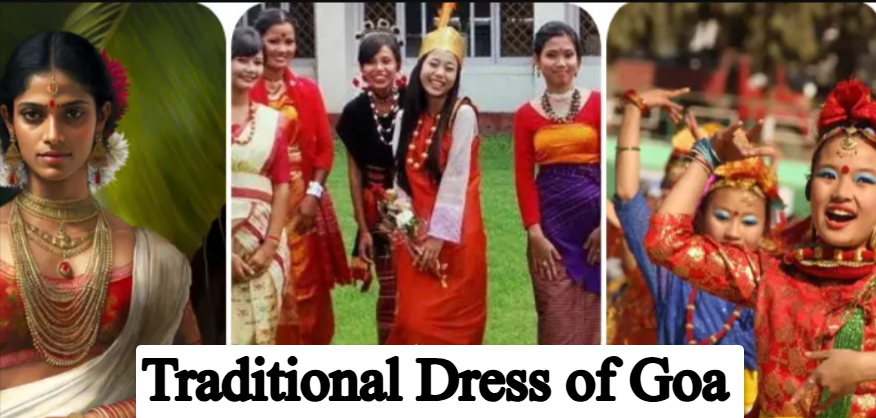
Yes, you may have made multiple failed trips to Goa. If you have ever been to Goa, then apart from the exciting beach life, the clothing is what people find quite interesting. You can see the elements of Portuguese, Indian and Muslim culture. Here, fashion is also influenced by these elements.
The indigenous Indian and colonial Portuguese aesthetics are shown in their ancient costumes. Their clothes are specifically designed to be worn in a tropical and humid coastal climate. Some of the iconic pieces include Kunbi saree and Dhoti Kurtas.
Traditional Dress of Goa For Women!
- Kunbi Saree
The dress originated from the indigenous Kunbi tribe. It is a cotton Saree produced in deep red colour with a checked pattern. The drape is made just below the knee, providing enough flexibility for people to work in paddy fields. It is a practical yet elegant design.
- Pano Bhaju
It is a cultural fusion outfit especially worn by the Christian community. It comprises Pano and Bhaju. A pano is a wrap-around sarong, and a Bhaju is a loose, European-inspired blouse. Their blouses are generally decorated with delicate lace trim, frill and intricate embroidery.
- Nauvari
It is a traditional 9-yard saree quite popular among Hindu and Koli women. The Saree is draped without a petticoat so that women can have a trouser-like comfort and appearance.
Gold necklaces, Bengals and Kashti generally accompanied the attire. It was worn historically by communities like Gauda, Dhangar and Velip.
Traditional Dress of Goa For Men!
The men’s costumes are tailored according to the coastal climate of the region.
- Dhoti and Kurta
Goa’s Hindu men wore a simple cotton dhoti with a kurta.
- Fishermen’s dress
The Koli fishing community’s men wear colourful and brightly patterned shirts along with half pants or lungis. They accessorise their attire with a hat made of bamboo bark.
- Kabai
It is a tunic-like dress which the local village bakers wear.
Kids’ clothing: A mini version of adult styles!
Goa’s kids are dressed in mini versions of adult styles. It keeps the tradition alive. They get dressed themselves, from tiny Kurtas to colourful sarees that reflect the cultural heritage of the place. The family affair is a festival, when everyone is dressed in traditional dresses.
Dresses with the influence of Indo-Portuguese!
The Portuguese legacy has been there for 450 years. Also, it is clearly visible in formal or ceremonial dresses of upper-class families.
Their attire is highly influenced by European fashion. Women used to wear elaborate floor-length gowns and dresses with featured corsets and ruffles.
The jewel: Ornaments!
The galsiri: It is a standout jewel. It is a striking necklace composed of gold and coral beads.
Pake: Women adorn themselves in a pake, which is a leaf-shaped ear cuff.
Rosaries: Catholic traditions influence the jewel piece. You will love to wear gold necklaces with carved rosaries and crucifixes.
Conclusion!
Goa is a sun-kissed paradise. It is not just all about the beautiful beaches and nightlife, but it is a rich tapestry of religion and history. The people of Goa carry their legacy and get into traditional attire on special occasions, festivals, folk performances and so on. Basically, their attire is made with lightweight fabrics.