
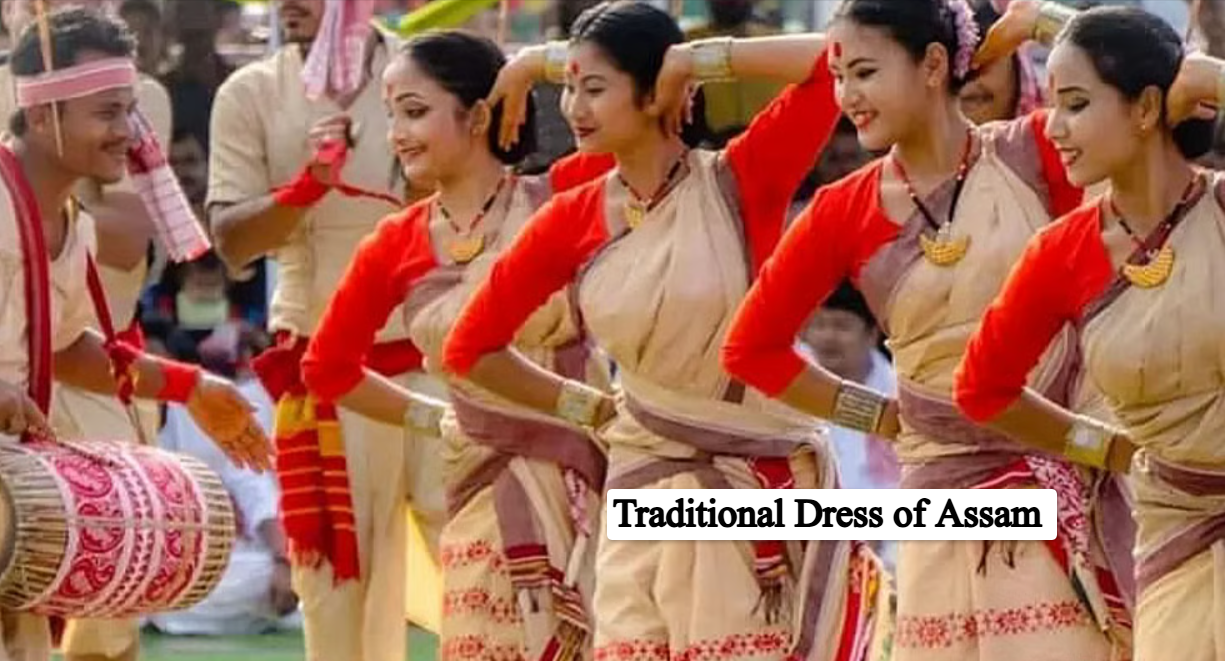
Within the rich cultural diversity of various communities in Assam, the traditional dress portrays the unique identity of each. For women, no attire is as popular as the two-piece Mekhela Chador- a wrapped skirt at the waist with a part held over the shoulder. Women attire also comprises the Sualkuchi Saree, a highly prized and exclusively worn dress by the bride, woven with the golden colored Muga silk of Assam.
Traditional Dress of Assam for Men and Women!
- Different tribes wore unique traditional dresses. Dimaşa women wear the Rigu. It is a very long and loosely woven ankle-length skirt, tied at the waist, followed by the Rii-amphai (or Ri-khaosa)-a dress interwoven with colourful beads and intricate embroidery worn at the top. The lighter, plain design of Bathormai, woven in strong bright colours, is a variation of the Rigu.
- Rabha tribal women weave a Koum Kontong with the help of the backstrap loom, which is very colourful and used with a Kambang.
- Bodo tribal women use the Dokhna, which is a single large piece of elaborately decorated silk or cotton material that can be wrapped around the body in various fashions.
- Missing tribal women use a Mekhela Chador that has been traditionally dyed a deep black and named the Yakan Age-Gasar. Thai Phake women were seen with a very light, striped Chairchin skirt and an intricately embroidered waist girdle. Nowadays, youngsters mostly wear a more versatile outfit known as Salwar Kameez.
Traditional Dresses for Men!
A Dhoti (Suria), the bottom wear, and is mostly worn with a Kurta and a Seleng shoulder wrap.
A rectangular white cloth which has a deep red border called Gamosa, signifying Assamese culture, is worn by both men and women.
The accessories to complete these dresses include the traditional Assamese ornaments.
- Joonbiri- the pendant looks like a crescent moon
- Dholbiri-the pendant resembles a drum shape
- Lokaparo-a pair of parrots, signifying the couple’s love
- Dugdugi- a pendant shaped like a leaf
- Thuriya & keru- the earrings are heavy and heavily ornamented
- The original ornaments can be purchased at Zangfai (Silphukuri) for classic heritage wear and Angana for modern Assamese ornaments, in Guwahati.
Know about some iconic Assamese jewellery pieces!
- Jonbiri
It is a crescent moon-shaped pendant necklace. It represents the moon called Jon. The jewel piece is highly popular in bridal or festive sets.
- Lokaparo
It is a distinct necklace. It features twin pigeons that are placed side by side. The pair of pigeons symbolises peace and love.
Other jewel pieces that are worn there are Dholbirio or Dhol Biri, which is a folk drum-shaped pendant; Jethi Poti; Gemkharu and Keru; and Thuriya.
Conclusion!
Be it the grace and timeless beauty of the Mekhela Chador or the vivid tribal prints of the Dokhna and Rigu, Assam’s indigenous traditional ensembles are visual essays to the locale. Adorned with intricately patterned handwoven Gamosas that are as rich in symbolism as they are in beauty and set apart by iconic jewellery patterns such as the Joonbiri, these ensembles, however, are much more than outfits- these are the stories of Assam as it has lived on through its gifted weavers, carrying the state’s handloom heritage into a bold present.