
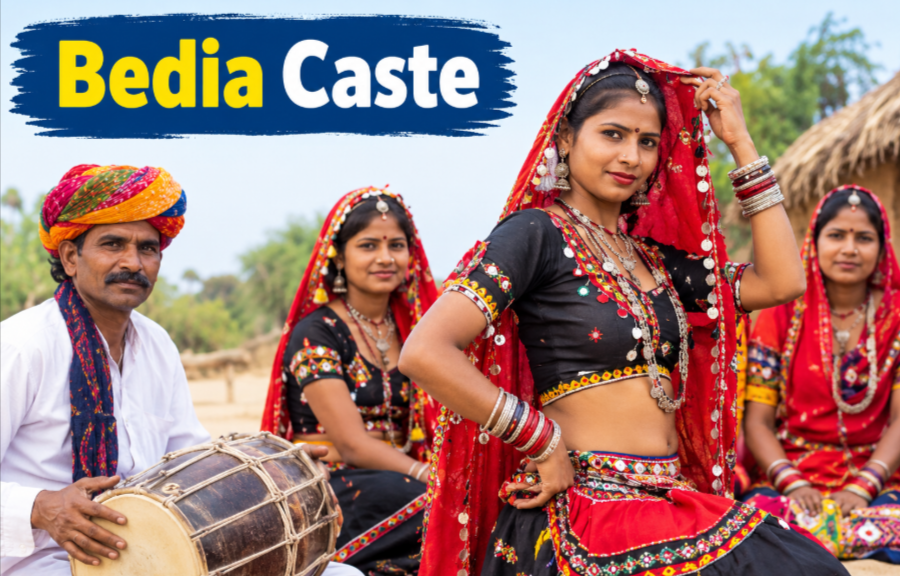
The Bedia caste is also known as the Bediya and Beria community. The community is primarily found in various states of India, such as:
- Madhya Pradesh
- Bihar
- Jharkhand
- Uttar Pradesh
- West Bengal
Historically, they were categorized as Scheduled Castes, depending on regional governance. The caste is present in various northern and central parts of India. They were closely linked with the rural settlements.
Their history is intertwined with:
- Forestry
- Performance arts
Their history!
The community was initially forest-dwelling. They relied on
- Forest production
- Hunting
Over time, they became known for their expertise in:
- Acrobatics
- Traditional dancing
- Storytelling
- Singing
They have developed distinct languages or dialects in their areas.
During the colonial era, the community faced various challenges. The Criminal Tribes Act of 1871 classified the Bedias as hereditary criminals. It affected their identity and restricted their mobility.
Their Geographical Distribution
The Bedia community is found across eastern and central Indian states. The most important region is Jharkhand. Other states where you can find the community are:
- Bihar
- West Bengal
A small population has also been recorded in the neighboring areas. With migration, geographical presence has increased. The community members have migrated due to:
- Agricultural work
- Employment opportunities
- Education and other reasons
Bedia Caste in Jharkhand!
The state has numerous tribal and rural communities. The Bedia family lives in various villages and adjacent forest areas. Agriculture was an important part of their livelihood. However, modern education and the government have uplifted their status. They are now enjoying a modern lifestyle with new opportunities.
The stigma of de-notification!
De-notified tribe
The Criminal tribe act was repealed in 1952. This is when the community was officially de-notified.
The community is classified as:
- SC
- OBC
- DNT
It varies from region to region
The social bias and the tag associated with the community made their lives tough. They have restricted access to mainstream employment, housing and so on.
Their social structure and cultural practices!
The community maintains a close-knit social structure. They have made community councils. These councils handle:
- Internal disputes
- Family matters of the community
- Cultural observances
They have a rich heritage of:
- Oral traditions
- Performance
- Music
A part of the community relies on:
- Traditional dances
- Entertainment
- Sex work
for their living.
Language spoken!
People speak different languages from region to region. Families used to speak.
- Hindi
- Bengali
- Sadri and other regional languages
An important part of their social life is:
- Music
- Dance
- Festivals and family Cultural practices
Economic status and marginalization!
One significant challenge is economic instability. They were landless and nomadic. A large majority of the population does not own agricultural land. The community members were engaged in:
- Seasonal agricultural labor
- Daily wage work
- Informal construction sector
The low literacy rate compounds the challenges. The community has faced poverty and social exclusion for a long time.
Government initiatives that uplift the community’s life!
The state and central government have introduced various welfare schemes to support the tribes. The government has established:
- National Commission for De-notified
- Nomadic
- Semi-Nomadic tribes
These categories were established to assess their living conditions. Policy intervention is done to improve:
- Education access
- Housing facilities
- Employment opportunities
States like Madhya Pradesh have also taken specific initiatives. They run a scheme called the Jabali scheme. The scheme was launched to eradicate caste-based sex work and rehabilitate women and children.
The program focuses on providing:
- Free education
- Vocational training
- Financial assistance
- Education
Access to schools has expanded in many areas. Government initiatives have been taken. Young people from the community are working in diverse fields. They are pursuing higher education, leading to better employment opportunities.