
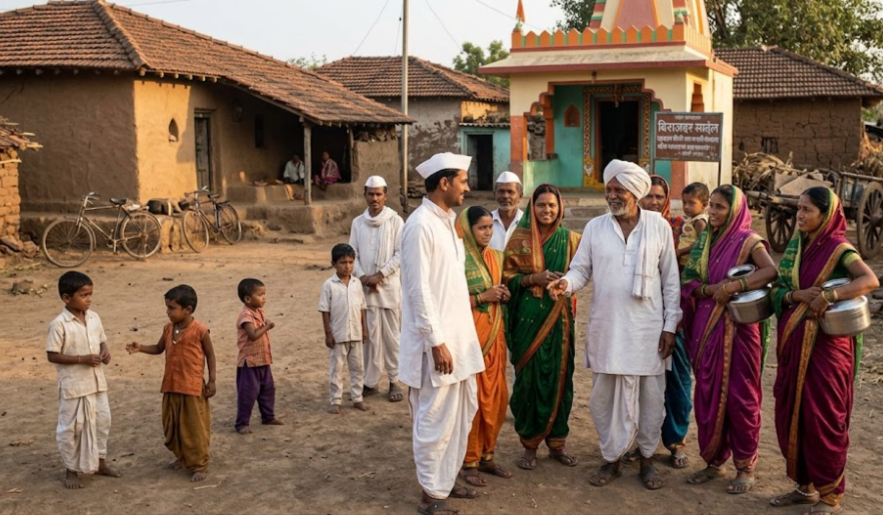
Birajdar Caste is found in western and southern India. Their main presence lies in:
- Maharashtra
- Karnataka
- And surrounding regions
The community is associated with Marathi-speaking families. The term Birajdar is used as a title. It was bestowed on individuals who held administrative responsibilities. Here, we will talk about:
- Family history
- Geography
- Occupation
- Ancestral connections
Learn about their historical origin and meaning of Birajdar Caste:
The roots of the Birajdar name trace back to traditional agrarian society. They were often associated with the administrative framework and land management. They played roles like:
- Revenue collectors
- Village officials
The name demonstrates a position of responsibility and leadership. Some of the community members were also agriculturists. In village affairs, they held their respective status.
Learn about graphical distribution
The Birajdar community is present in:
Maharashtra
They are found in Marathwada and Solapur regions.
Karnataka
They have a strong presence in districts:
- Bidar
- Kalaburagi
- Vijayapura
Language spoken
Many families in the community are fluent in Marathi and Kannada. They blend the cultural traditions, food habits, and festivals of both states.
Their social and cultural customs
Their religion plays an important role in the community. Mainly, they follow Hinduism. They are deeply connected to the Bhakti Movement and local deities.
Worship deities
They frequently worship:
- Lord Shiva
- Vitthal of Pandharpur
- Several local Grama Devatas
Festivals
They celebrate festivals like:
- Diwali
- Dussehra
- Ugadi
- Gudi Padwa
With lots of fun and pomp
Family structure
Traditional families prefer the joint family system. However, there is now a trend toward nuclear families among the younger generation.
Marriage alliance
Marriages are within the community. Birajdar Caste People follow specific rules and rituals.
Their caste affiliation and social structure!
The families belong to the Maratha caste. They identify with sub-lineages like 96 Kuli Maratha. According to the framework, they occupied the
- Kshatriya’s status
- Vaishyas status
Status is based on duties and responsibilities.
- Kshatriyas status: Given to the warriors
- Vaishyas status: Agriculturists
In Karnataka, some lineages share similar administrative titles. In official Indian administrative classification:
In Maharashtra, an individual from the community falls under a general category.
Their ancient cultural roles!
Earlier, the Birajdars were agrarian elites. They also possessed landholdings in rural areas. However, their duties were:
- Agricultural management
They oversaw expansive cultivation fields and managed agrarian labor.
- Village conflict resolution
They served as administrative intermediaries. They resolved civic disputes alongside Deshmukh or Patil.
- Marital contribution
They provide youth and resources to Maratha armies during the period of political consolidation.
Talking about the modern status and transition!
The contemporary Birajdar community has transitioned away from agrarian dependency. Today, we can see the members of the community working in various professional sectors like
- Teaching
- Government sector
- Engineer
- Doctor
- Civil servants
- Educators
- Private or public companies
- Corporate professionals
They have adapted to modern protocols. They have migrated to urban hubs like:
- Pune
- Mumbai
- Solarpur
- Bengaluru
Education has been a key catalyst.
Bottom line!
The community name is tied to a rich administrative and agrarian history. They have transitioned from historical village administrators to modern-day professionals. They belong to a lineage that carries forward their heritage of kinship.