
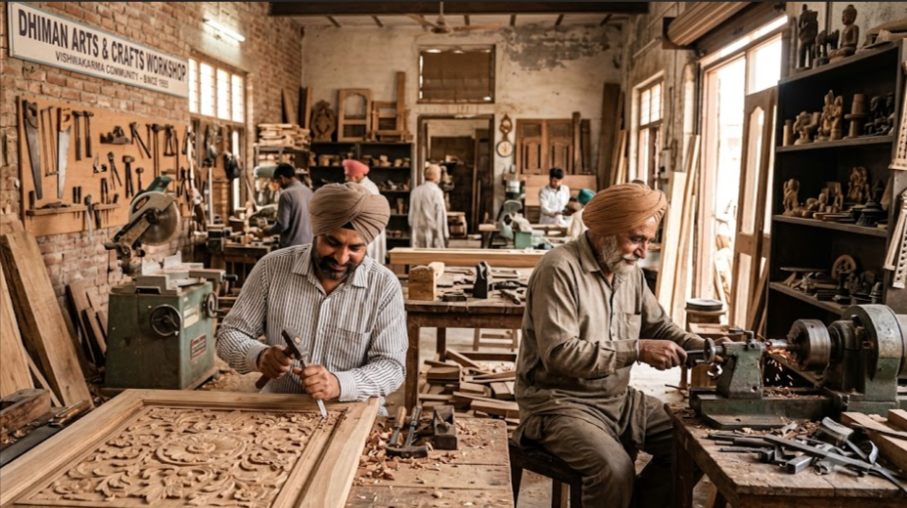
Dhiman Caste community is present mainly in North India. It is a Hindu artisan and craftsman community. Traditionally, the community members are associated with carpentry, architecture and skilled manual labour.
Key aspects!
- Meaning of the name: Wise and knowledgeable
- Lineage: Vishwakarama’s son
- Work of engineering: Buildings, large temples and essential machinery
- Geographical distribution: North Indian states
Assessing their roots!
Their roots can be traced to a subgroup of the Vishwakarma community. They used to worship Lord Vishwakarma. According to some beliefs, they are descendants of Vishwakarma’s five sons.
Although most of them practice Hinduism, many have adopted Sikhism. They have taken the surname Ramgarhia.
Traditional identity of Dhiman Caste!
They were recognised for their skilled craftsmanship. They focus on fields like engineering and architecture. Some of the community members are also skilled
- Carpenters or woodworkers
- Construction worker
- Artisan
- Goldsmith
- Blacksmiths and stone Masons.
They are known to pass skills from one generation to the next.
Their religious identity and divine lineage!
They are linked to the divine architect of the universe, Vishwakarma. Their five sons gave birth to five artisans of the community.
- Manu: Lineage of Blacksmiths
- Maya: Lineage of Carpenters
- Thwastha: Metal craftsmen
- Silpi: Stone carvers and sculptures
- Vishvajnya: Goldsmiths
That is why they are also called Vishwa Brahmins. Before, Brahmins focused on scriptures or religious Rites. However, Dhiman focuses on architecture and building work.
Geographical Presence!
The community members are mainly present in North Indian states. They are found in
- Punjab
- Haryana
- Himachal Pradesh
- Rajasthan
- Parts of Uttar Pradesh
- Delhi
Their identity varies from one region to another.
Social status and classification!
Their social status is not the same across India. It varies. In Haryana, they come under the OBC category. In hilly regions, they come under SC listings. Even customs and occupations vary.
In rural areas, families earn through agriculture and craftsmanship.
Religious practices!
They wear the sacred thread (Janeu). Most families follow Hindu traditions. Local traditions influence rituals and worship.
Modern transition with changing occupations!
Industrialisation has transformed their craft-based employment. Now, individuals have moved into modern professions. They have shifted towards formal education.
They have gained huge recognition in various modern fields. Many members have become successful:
- Engineers
- Mechanical engineers
- Civil architects
- Business man
- Owners of corporate offices
- Government services
- Technology
- Healthcare
- Skilled traders
Community members have also migrated to Western nations like the UK, the US, and Canada.
Women in the Community!
Traditionally, women contribute to household activities.
Now, they have increasing access to education. They have entered various professions. They now work in various industries, including business, healthcare, education, and so on.
Marriage Traditions and festivals!
Marriage practices vary among Dhiman families. It depends on regional customs and family preferences. Urbanisation has also transformed the practices.
They used to celebrate various Hindu festivals like
- Diwali
- Holi
- Dussehra
- Navratri
- Makar Sankranti.
- Vishwakarma Jayanti is celebrated with many rites and celebrations.
Conclusion!
Now, education and urbanisation have diversified occupations. They have shifted away from manual workshops. Modern community members have achieved huge success. They have succeeded in various professions, such as engineering, architecture, and technology.