
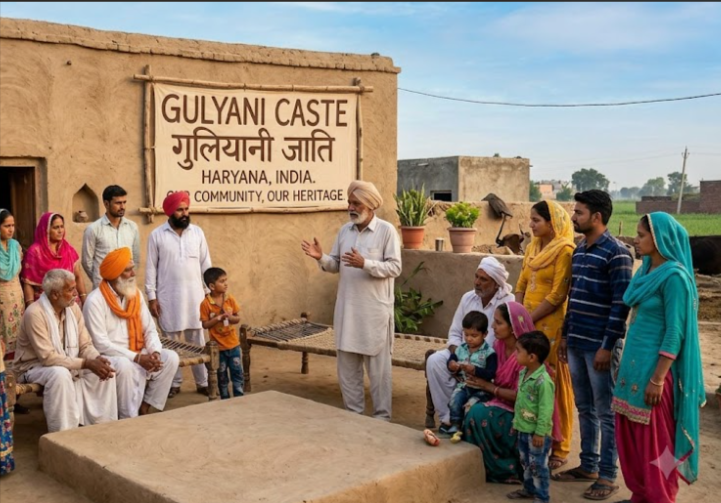
The Gulyani caste is a surname. It is a distinct lineage in the northern region of the Indian subcontinent. Clan members belong to Hindu and Sikh communities. They can also be found in states like:
- Delhi
- Haryana
- Punjab
Linguistic and etymological origin of Gulyani Caste!
The name derives from the Persian word Gul. The word means flower. The word Yani signifies belonging and origin. The name conveys a connection to flowers, beauty, and nature. It shows their association with gardening and agriculture. Over time, the title evolved into a family surname.
Origin!
The Gulyani surname is not documented in one universally accepted historical source. Different families may have their own traditions. Many Indian surnames developed inspired by:
- Places
- Occupations
- Family names
- Ancestral associations
The Gulyani surname has developed through regional and family connections. Oral traditions can provide additional information. However, these traditions can differ from one family to another.
Geographical Distribution!
Gulyani families are commonly associated with northern India. The surname can be seen in various places, such as:
- Delhi
- Haryana
- Punjab
- Rajasthan and nearby regions
Over time, families have moved to various cities. This increases the geographical presence.
In modern times, the clan members also live in cities such as:
- Mumbai
- Bengaluru
- Pune
- Chandigarh
Some families have settled outside India as well. Migration has made the community more diverse. It creates cultural connections.
Social and community ties!
In the Indian social structure, family names are associated with community groups. The surname is associated with the Arora and Khatri communities. It also has a connection with:
- Chawla
- Arora
These mercantile clans are involved in:
- Administration
- Agricultural management
- Trade
What is the impact of the 1947 partition on the community?
1947 brought a massive turning point for families. The partition forced people to migrate across newly formed borders. Many families are living in the western part of Punjab. Later, it became Pakistan.
During partition, these families had to leave their ancestral land. Then they moved to eastern India. These families have rebuilt their lives. They learned vocational skills like tailoring. They transitioned from landowners to traders.
Knowing their ancient lifestyle!
Like many other communities in Northern India, families have associated it with the Gulyani surname. They have experienced changes in traditional lifestyle. The older generation was engaged in
- Agriculture
- Business
- Trade and other skilled activities
Later, urbanization has changed the pattern. Access to education has opened new career opportunities. They have also entered various professional fields. This leads to a continuously evolving lifestyle.
Young people are pursuing different educational paths. Some choose engineering and medicine. Others study various programs like
- Commerce
- Management
- Law
- Teaching
- Technology
Professional careers are quite common. They are also working in private companies, government organizations, financial services, education, healthcare, and entrepreneurship.
Contemporary presence with global diaspora!
The community is highly urbanized and progressive. Education is highly valued within the families. Education has enabled members to excel in various diverse fields. They have made significant marks in creative arts, academia, and public policy.
Conclusion!
The surname represents a family identity whose background varied across regions and households. There is no single explanation that applies to the family. Migration, access to education, and urbanization have transformed their lives. Today, Gulyani families can be found in many professions and locations.