
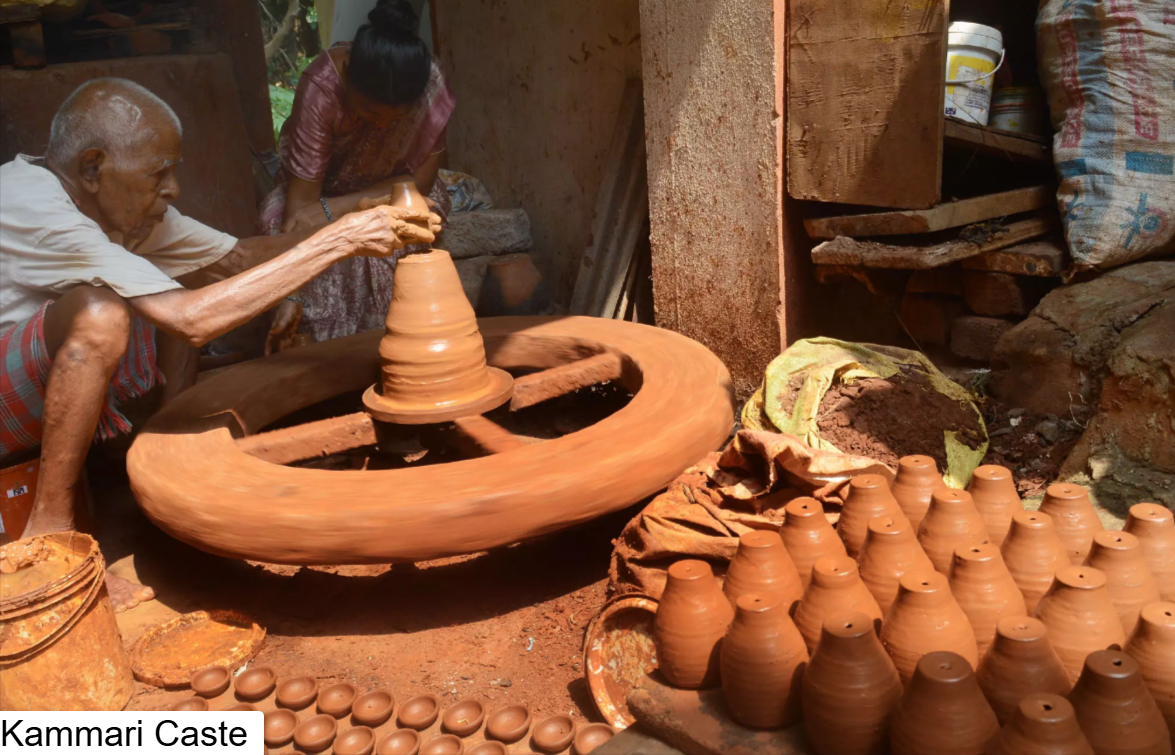
Kammari caste is a traditional community of Blacksmiths found in the southern states of India, such as:
- Andhra Pradesh
- Telangana
- Parts of Karnataka
It belongs to the large Vishwakarma community. They play an essential role in the agrarian economy.
The community has a long association with Telugu-speaking regions. They have played an essential role in the agrarian economy. Their families are associated with blacksmithing. They can make and repair iron tools.
Their historical and mythological origins!
The Kammaris derive their identity from the Vishwakarma community. They are five artisan groups.
- Goldsmiths (Kamsali)
- Carpenters (Vadrangi)
- Brass-smiths (Kanchari)
- Stonemasons (Silpi)
- Blacksmiths (Kammari)
Mythologically, they trace their lineage back to lord Vishwakarma. They are descendants of Manu, Vishwakarma’s first son. He was regarded as the master of Iron and Metalwork.
Kammari and Vishwakarma community!
Kammari is included among the five occupational divisions. They are associated with Vishwakarma and Viswabrahmin.
The other divisions include:
- Goldsmiths
- Brass or metal workers
- Carpenters
- Stone workers
Traditional blacksmithing!
Blacksmithing was a central traditional occupation. A village worked with iron using tools:
- Furnace
- Hammer
- Anvil and other tools
The work required considerable practical knowledge. The craftsman had to understand how heat affected the different metals.
All villages needed a blacksmith to make the tools necessary for survival. They manufacture:
- Heavy ploughshares
- Sickles
- Aces
- Spades
- Other weeding hooks required by the farmers
Their connection with agriculture!
Traditional agriculture depends heavily on tools. Farmers need to implement:
- Ploughing
- Cutting
- Digging
- Harvesting and other activities
Kammari blacksmiths produce and repair these items. They create an economic relationship between blacksmith families and households.
In addition to farming equipment, they also make household items. They create:
- Household items
- Kitchen utensils
- Structural metal fittings for temples and houses
Tools Made by Kammari Artisans!
Traditional blacksmiths produced many types of iron implements. They manufacture:
- Plough components
- Sickles
- Axes
- Knives
- Other agricultural tools
They also repaired worn or damaged equipment. The range of products depends on local requirements.
Community organization!
Traditionally, community organization forms part of Kammari social life. Ethnographic research from Telangana describes a group of senior blacksmiths. These elders could help settle disputes. Local religious traditions are also connected with community life.
Their social status and structure!
Socially, the Kammari caste occupies a unique position. They were classified under:
Other backward classes (OBC)
They traditionally wear a sacred thread. Also, they follow vegetarian customs similar to upper castes.
Endogamous:
It means marriages are typically arranged within the caste. They are divided into various clans, which help regulate matrimonial alliances. They celebrate festivals:
- Dedicated to the lord Vishwakarma
- Vishwakarma Puja
- Ayudha Puja
- Kammari in Andhra Pradesh
Kammari is present throughout the plains of Andhra Pradesh. A government-related legal record shows the Kammara caste as a Telugu blacksmith community. It is not the Kammara tribal community, which is an SC in AP.
Kammari in Telangana!
Telangana has a strong historical tradition of rural blacksmithing. The traditional craft involved producing iron tools for agricultural communities.
Contemporary transition and education!
The modern generation of the Kammari caste is pursuing higher education. Urban migration has also changed their way of life. They are also working in various fields in:
- Engineering
- Technology
- Administration
- Private business
Their inherent technical quality has been passed down through generations. They excel in:
- Mechanical engineering
- Metallurgy
- Architectural fields