
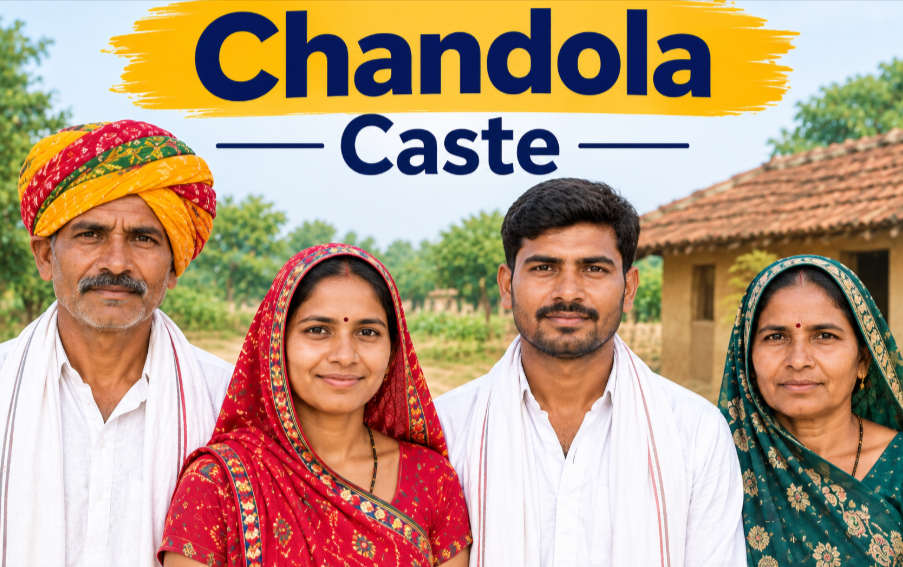
Chandola Caste is mainly found in parts of North and Central India. It constitutes a significant Brahmin lineage rooted in the central Himalayan region of Uttarakhand, India. The community is found across the landscapes of:
- Garhwal
- Kumaon
The caste with the Chandola surname occupies a highly respected status.
The history of the Chandola community is connected with:
- Local social traditions
- Family lineage
- Occupations
- Migration patterns
Knowing about their history, cultural practices, and modern-day transitions shows how the caste has shaped modern life.
Chandola Caste meaning and identity!
The name Chandola is used as a surname in various parts of India. Different groups in different regions can also use the surname.
Their name’s etymology!
The surname Chandola is believed to have linguistic roots. It comes from the Sanskrit word called Chand. It signifies the moon. It is compounded with the moon, which denotes the origin. Therefore, the symbolic derivation shows the traits of the community related to the celestial body, such as:
- Calmness
- Intellectual brightness
- Spiritual clarity
The community evolved as a specialized group of the Brahmin population. They preserve their scriptural knowledge. They served as pillars:
- Spirituality
- Administrative infrastructure
Their geographical distribution!
The Chandola name is linked with various parts of North India. Initially, they were geographically located in northern and central India. However, after migration, their families are living in the major cities across the country.
They have migrated for the betterment of life for:
- Better education facilities
- Employment opportunities
- Business
- Professional careers
As a result, today’s community has a diverse presence across the entire country.
Talking about the Kumaon region, the community has established deep roots in the Bageshwar district. They are highly concentrated in ancestral villages named
- Pokhri near Vijaypur
- Kafligair
As per some scholars, many Kumaoni Chandolas are traced back as descendants of Mishra Brahmins. Their ancestors migrated from the Garhwal region to Kumaon.
Their traditional occupation!
The traditional occupation associated with the community has completely changed over time.
Historically, the community members were involved in:
- Spiritual leadership
- Intellectual pursuits
- Religious Rites
They also depended on:
- Agriculture
- Trade
- Administration
- Crafts
- Local service
They have followed different occupations according to specific location and circumstances.
In modern times, the community has undergone significant changes with access to education. They have built successful careers in diverse professional domains like
- Education
- Government services
- Business
- Technology
- Healthcare
- Finance
- Engineering and other professional fields
Their religious beliefs, cultural traditions and deities!
Spirituality and ancestral worship play an important role. They are dependent on their exact geographic lineage. The community families also worship their guardian deities.
The community members who are linked to the Kumaon region primarily worship their Ishta Devata. Their Ishta Devata is Dhauli Nag. There is a temple dedicated to Dhauli Nag in Vijaypur. An annual fair is hosted there where loads of community feasts are prepared.
Chandola Community in Urban India!
Urbanisation has significantly influenced community life.
Professional networks have also become more important. Young members are working in a diverse range of professions and companies, such as:
- Multinational companies
- Startups
- Public-sector organizations
- Educational institutions and other professional environments
Know about their social identity and legacy!
Today, they have created a balance between the traditional Pahari values and modern professional citizenship. The community is highly proud of its:
- Rich folklore
- Language
- Cultural contributions
Notable figures carry the surname:
- Late Indian journalist Harish Chandola
- Anoop Chandola
They reflect the long-standing dedication to the creative discipline of the community.